How Restoration Takes Root

Three Steps to Planetary Impact

Meaningful ecological restoration does not happen overnight. Our connected three-stage roadmap empowers individuals and communities to move from local awareness to active planting and generational stewardship.

Phase 01 Β· Intelligence

Map & Understand Your Local Bioregion

Begin by exploring open satellite canopy coverage and native biodiversity maps in your watershed. Identify ancient corridors fragmented by urban sprawl and discover which indigenous plant species need urgent repopulation.

Open Canopy Maps Watershed Audits Bio-Corridor Pinpointing
Phase 02 Β· Intervention

Geospatial Canopy Mapping & Living Corridors

Under our planned restoration framework, we aim to map community rewilding pods and native sapling plantings into public bioregional GIS layers [PLACEHOLDER: Open Registry Schema]. Every micro-grove is envisioned to follow open tree registry schemas and receive structured support from volunteer stewards during the critical three-year establishment window.

Planned: GIS Canopy Telemetry Hands-on Rewilding Pods Planned: 3-Year Stewardship Protocol
Phase 03 Β· Multiplication

Monitor Canopy Health & Multiply Impact

We aim to explore using public satellite data such as Copernicus Sentinel-2 multispectral NDVI imagery and NASA GEDI canopy height lidar telemetry, alongside community bio-acoustic sensors [PLACEHOLDER: Research Pilot]. We aspire to share open-source stewardship toolkits with schools, universities, and municipal partners as pilot initiatives develop.

Planned: Open Carbon Telemetry Planned: Bio-Acoustic Tracking Planned: Municipal Advocacy
Practical Stewardship Β· Choose Your Timeline

Ways to Act Today

Restoration is not an all-or-nothing commitment. Whether you have five spare minutes between tasks, an open weekend, or a long-term civic vision, choose an actionable pathway tailored to your availability.

5 MIN Everyday Choices

Audit Your Household Paper & Wood Footprint

Inspect your pantry and utility cabinets for certified post-consumer recycled paper products. Opting for 100% recycled tissue and FSC-certified fiber prevents virgin ancient forest logging, saving up to twelve mature trees per household every single year.
No tools needed Saves 12 trees/yr
5 MIN Digital Action

Switch Your Search Engine to Canopy Support

Set your default browser search engine to a tree-planting provider like Ecosia. By redirecting everyday web search ad revenue directly toward reforestation pods, you can fund several indigenous saplings each month with zero out-of-pocket personal expense.

Browser setting Funds ~4 trees/mo
5 MIN Ecological Literacy

Pinpoint Native Seedlings via Local Floras

Download a free biodiversity app like iNaturalist or your state extension service database. Spend five quick minutes identifying two keystones indigenous to your county, discovering whether native oaks, birches, or dogwoods are best suited to your microclimate.

Mobile discovery Bioregion literacy
5 MIN Civic Voice

Sign the Bioregional Ancient Forest Petition

Lend your civic signature to pending regional canopy conservation bills protecting old-growth timber stands. Rapid legislative mobilization signals voter priority to local representatives, safeguarding critical carbon reservoirs and contiguous wildlife pathways in under five minutes.

Advocacy action Policy protection
Residential Rewilding Β· Practical Field Guide

Plant at Home: Native Manual

Transforming your yard or neighborhood parcel into a thriving biological shelter starts with foundational planting science. Follow our field-proven 5-step native planting guide and seasonal maintenance calendar.

Step 01

Choose an Indigenous Native Species

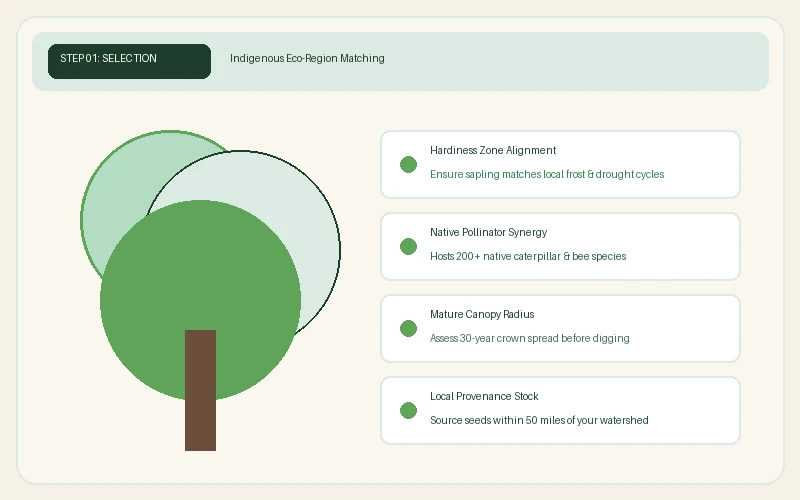
Always prioritize tree species native to your specific eco-region and USDA hardiness zone. Native species have co-evolved over millennia with local soil microbes, pollinators, and weather patterns. They require vastly less supplemental irrigation once established and host hundreds of native lepidoptera and bird species that non-native ornamentals cannot sustain.

  • Check regional seed provenance within 50 miles of your watershed.
  • Evaluate 30-year mature height and crown spread relative to power lines and foundations.
  • Prioritize keystone genera (such as Quercus, Betula, and Prunus) for maximum biodiversity.
Educational diagram for selecting native tree species based on hardiness zones and biodiversity
Step 02

Prepare the Living Soil Horizon

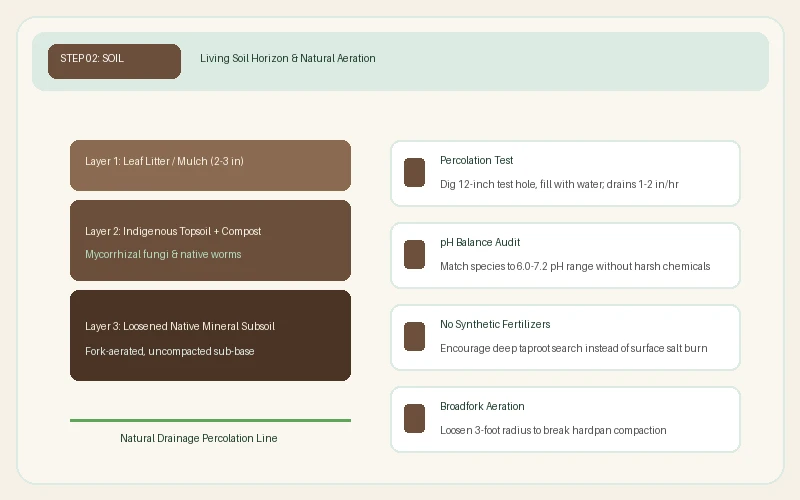
Healthy trees grow in living soil, not sterile dirt. Avoid digging a deep pit with glazed clay walls. Instead, loosen a wide circular radius around the planting zone using a garden fork to alleviate urban compaction. Never introduce heavy synthetic fertilizers into the planting hole, which scorches tender new roots and discourages natural mycorrhizal symbiotic associations.

  • Perform a 12-inch percolation test: water should drain at 1 to 2 inches per hour.
  • Incorporate mature local compost into the top 4 inches of backfill only.
  • Keep the hole bottom firm and undisturbed so the tree cannot sink over time.
Cross-section diagram showing soil horizons, drainage percolation, and aeration techniques
Step 03

Master Planting Depth & Root Flare Alignment

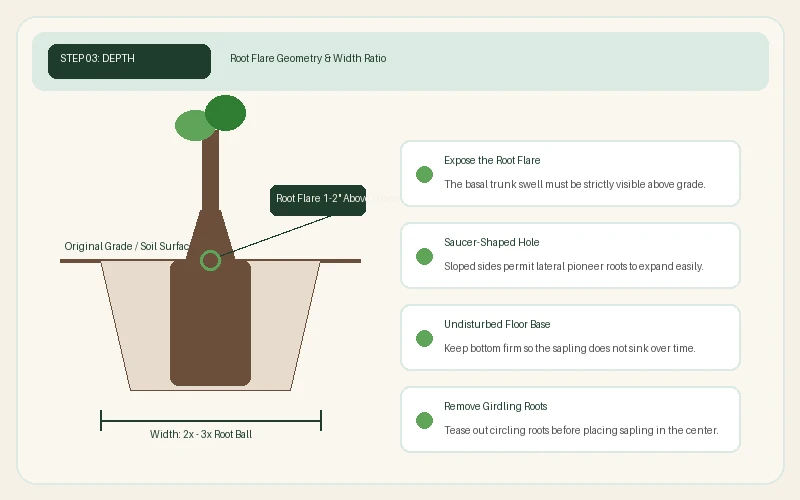
The single most common cause of premature young tree mortality is planting too deeply. Locate the trunk flareβ€”the point where the basal trunk widens into the main structural roots. The trunk flare must remain completely visible and sit 1 to 2 inches above the surrounding soil grade. Dig the hole 2 to 3 times wider than the root ball, shaping gently sloping saucer walls.

  • Gently tease out circling or girdling roots before lowering sapling into position.
  • Verify root flare visibility before backfilling any soil.
  • Tamp backfill soil gently with your handsβ€”never stomp with heavy boots.
Illustration of saucer-shaped planting hole with root flare aligned 1-2 inches above soil grade
Step 04

Deep Soak Irrigation & The 3-3-3 Mulch Shield

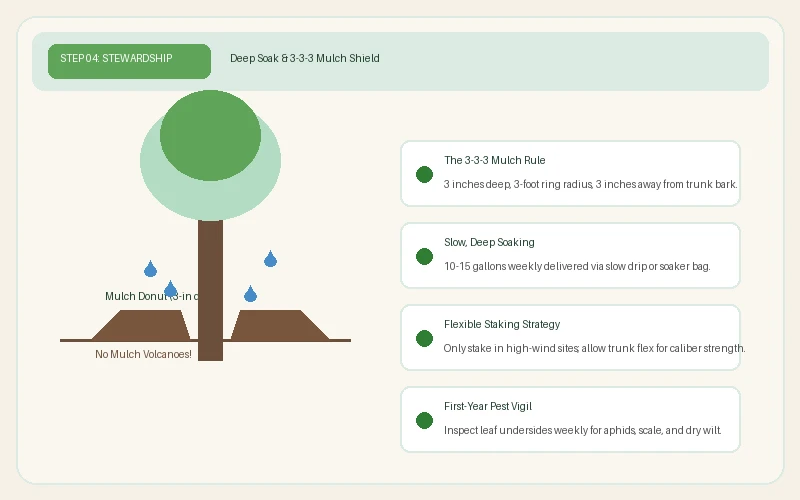
Newly planted saplings need consistent, slow moisture delivery rather than frequent shallow sprinkling. Apply 10 to 15 gallons of water immediately after backfilling to eliminate subsurface air pockets. Apply a mulch ring following the critical 3-3-3 Rule: 3 inches deep, 3-foot circular radius, and 3 inches of clear breathing space away from the trunk bark.

  • Never create "mulch volcanoes" touching the trunk; wet bark invites fungal rot.
  • Use slow-release soaker hoses or 15-gallon drip bags for gentle root infiltration.
  • Stake only in high-wind zones; allow natural trunk sway to build structural wood strength.
Diagram showing the 3-3-3 mulch donut rule and slow deep soak watering techniques
Step 05

First-Year Vigilance & Generational Care

The first 365 days determine your tree's long-term resilience. Resist the temptation to perform heavy structural pruning during year one; every leaf produces carbohydrates that feed expanding root tips. Conduct weekly visual health audits, checking leaf undersides for aphid colonies and inspecting the root flare for settling or rodent gnawing.

  • Remove only dead, broken, or diseased branches during the inaugural season.
  • Wrap young thin-barked trunks with breathable tree guards before winter to prevent sunscald.
  • Expand the diameter of the organic mulch donut annually as the tree canopy broadens.
92% Survival rate when following the 3-3-3 mulch rule & deep watering schedule
3 Years Critical establishment window before root networks become fully self-sustaining

Seasonal Tree Care & Maintenance Calendar

Plan your stewardship cadence across the four natural seasons to maximize sapling vitality and drought survival.

Season Core Stewardship Focus Watering Cadence Soil & Mulch Tasks Phenology & Biological Milestone
Spring Mar – May Primary Planting Window: Plant bare-root and container saplings before leaf buds burst. Inspect winter wind damage. 5–8 gallons weekly if rainfall is under 1 inch; test moisture 2 inches below surface. Replenish 2–3" organic woodchip donut; gently aerate compacted turf around the drip line. Bud swell, flower catkins, and tender early leaf emergence; rapid feeder root expansion.
Summer Jun – Aug Drought & Heat Defense: Monitor thermal stress. Avoid all heavy pruning and root disturbance. 10–15 gallons weekly delivered slowly at dawn via soaker ring or drip bag. Check mulch depth to prevent surface evaporation; ensure mulch does not touch bark. Full canopy expansion, maximum photosynthetic output; watch for midday leaf wilt.
Autumn Sep – Nov Second Planting Window: Ideal for balled-and-burlapped trees; soil warmth fosters roots while air cools. 5–10 gallons bi-weekly; deliver one deep saturating drench prior to first ground freeze. Top-dress with shredded native leaves; install wire mesh guards to deter winter rodents. Foliage coloration, nutrient reabsorption, and leaf drop; intense subsurface root growth.
Winter Dec – Feb Dormancy & Structure: Corrective pruning of crossing branches while canopy architecture is visible. No watering when soil is frozen; provide 5 gallons during prolonged dry winter thaws. Maintain 3" mulch buffer against freeze-thaw frost heaves; gently brush heavy snow off boughs. Dormant rest; terminal buds set with protective scales ready for spring awakening.
Interactive Tree Selector

Which Tree Fits Your Landscape?

Answer three rapid ecological questions to receive tailored recommendations for a generic native tree category suited to your space, soil profile, and biodiversity goals.

1 2 3
Question 1 of 3: Space & Site Scale
How much horizontal and vertical space is available on your site?

Consider mature branch spread and clearance from rooflines, overhead cables, and underground utilities.

Educational Outreach Β· Civic Stewardship

For Schools & Communities

Restoration flourishes when young learners and neighborhood groups collaborate. Use our printable one-page canopy audit sheet and structured discussion guide for outdoor classrooms and civic meetings.

FIELD PRINT RESOURCE Optimized for clean single-page printing on standard A4 / Letter paper.
Planetary Action & Canopy Stewardship

Neighborhood Canopy Audit & Planting Activity Sheet

Field-based ecological audit sheet for science students, youth eco-clubs, and neighborhood councils.

Student / Surveyor:
Date & Time:
School / Organization:
Location / Watershed:
Weather & Soil Moisture:
Hardiness Zone:

Part 1: Field Tree & Site Inventory

Tree # Species / Common Name Trunk Circumference (DBH) Canopy Health (1–5) Wildlife Observed / Notes
01
02
03
04

Part 2: Pre-Planting Rapid Site Audit Checklist

Overhead Clearance: Checked minimum 25 ft clearance from electrical utility lines.
Underground Check: Confirmed absence of buried pipes or requested utility mark-out.
Drainage Test: Confirmed planting hole drains water within 1 to 2 hours.
Root Flare Check: Ensure tree root flare rests 1–2 inches above surrounding grade.
3-3-3 Mulch Ring: Placed 3" deep mulch ring, 3 ft wide, kept 3" away from trunk.

Part 3: The Young Steward's Commitment

"I promise to check on this newly planted native tree every week during its first growing season, ensuring it receives adequate water, that its mulch remains clear of the trunk bark, and that its habitat is protected."

Steward Signature:
Mentor / Teacher:
Date:
Rooted Planetary Education Initiative Β· Free Open Resource Β· Visit rooted.earth for digital guides
FACILITATOR RESOURCE

Classroom & Community Discussion Guide

Use these four structured prompts to guide meaningful scientific dialogue following a neighborhood canopy audit.

01

Thermal Equity & Urban Heat Islands

"Why do satellite thermal maps show asphalt-dense neighborhoods up to 10Β°F hotter than adjacent tree-lined streets, and what health consequences does this create for vulnerable residents?"

Context for Facilitators: Discuss how shade, transpiration cooling, and concrete heat retention impact asthma, cardiovascular strain, and summer utility bills.

02

Keystone Species vs. Ornamental Trees

"Why does a single native White Oak support over 500 caterpillar species, whereas an imported Ginkgo or Callery Pear supports fewer than five?"

Context for Facilitators: Explore evolutionary chemical defenses, specialized insect feeding, and how caterpillar populations form the nutritional foundation for baby songbirds.

03

The Underground Mycorrhizal Web

"How do underground mycorrhizal fungal networks allow mature 'mother trees' to share water, carbon, and alarm signals with struggling young saplings?"

Context for Facilitators: Contrast isolated trees planted in sterile concrete sidewalk wells with high-density communal micro-forests where fungal hyphae connect root tips.

04

Civic Policy & Canopy Ordinances

"What municipal policies or school campus guidelines could our community pass to prevent clear-cutting mature trees during construction projects?"

Context for Facilitators: Introduce tree-replacement ratios (e.g., planting 3 saplings for every mature tree removed), tree preservation easements, and public street tree budgets.

Community Restoration Gatherings

Upcoming Stewardship Events

Connect with fellow planetary stewards at upcoming seedling distributions, stream buffer plantings, and citizen canopy mapping workshops.

SAMPLE COMMUNITY DATA

The restoration gatherings listed below represent demonstration workshop models. For scheduled active events in your county, check with your local conservation district, municipal parks department, or regional land trust.

APR 18
Seedling Distribution 09:00 AM – 1:00 PM

Spring Native Bare-Root Sapling Giveaway

Free distribution of 500 indigenous oak, maple, and dogwood whips with soil test kits and one-on-one planting advice from certified arborists.

MAY 09
Riparian Rewilding 08:30 AM – 12:30 PM

Mill Creek Stream Buffer Restoration Pod

Hands-on volunteer morning planting 350 native river birch and willow stakes to stabilize eroded riverbanks and filter stormwater runoff before it enters the bay.

JUN 14
Citizen Science 10:00 AM – 12:00 PM

Urban Canopy Mapping & Bio-Acoustic Walk

Learn how to measure trunk diameter, log biodiversity sightings in iNaturalist, and map street tree gaps on your mobile device during a guided 2-mile neighborhood walk.

OCT 10
Seed Lab 10:00 AM – 02:00 PM

Autumn Acorn Foraging & Cold Stratification Workshop

Master the science of identifying ripe keystone oak acorns, running float viability tests, and preparing winter cold stratification containers to germinate healthy spring trees.

Guidance & Clarifications

Frequently Asked Questions

Clear answers to the most common questions regarding native species sourcing, urban planting permits, and first-year seedling survival.